
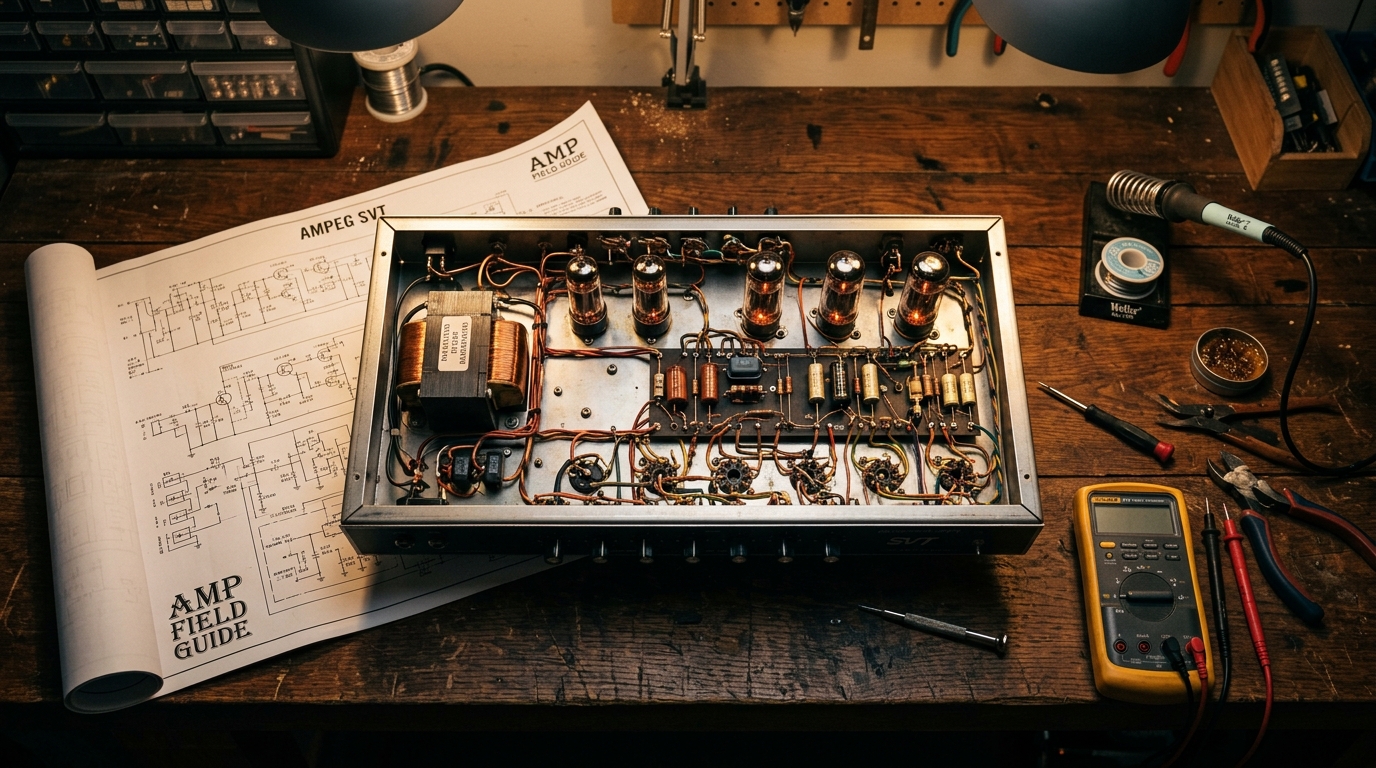
What I Asked For
The starting idea was straightforward: an interactive educational guide to electric guitar tones, organized around the signal chain, with visual spectrum displays showing where different gear sits relative to everything else. Not just a list of amps, but a way to see that a Fender Champ and a Diezel VH4 exist on opposite ends of the same axis, and that everything in between is a point on that line. The same idea applied to drive pedals, pickups, and speakers.
From there it grew into a two-way tool: you could set parameters and see which artists or tones you were approximating, or start from a famous tone and reverse-engineer the recipe. The Dimebag example is a good one. His “Cowboys from Hell” tone sounds impossibly aggressive, but when you break it down, it’s hot pickups pushing a solid-state Randall with a mid-scooped EQ. That’s a teachable, reproducible concept.
The final version that got built focuses specifically on amplifiers, organized into a field guide and a genealogy tree that shows how amp designs actually descended from each other. The Soldano SLO is a hot-rodded Marshall. The 5150 has its own bloodline. The Fender Bassman is the ancestor of more amps than most people realize. Seeing it laid out as a family tree makes the whole landscape make sense in a way that reading individual reviews never did.
What It Actually Is
No app store, no backend, no subscription. It’s a self-contained interactive React component, built entirely inside Claude as a single file. All the amp data, the lineage relationships, the narratives, everything lives inside that file. You open it in a browser and it works. If you want to add an amp or correct a relationship, you edit one array.
That’s kind of the point. The tool should be as simple as the idea it’s trying to communicate.
Leave a Reply